
How we turn signals into evidence you can defend.
Urban intelligence is only useful if it is defensible. Every claim GUS produces has a source, a date and a method. Here is the shape of that work.
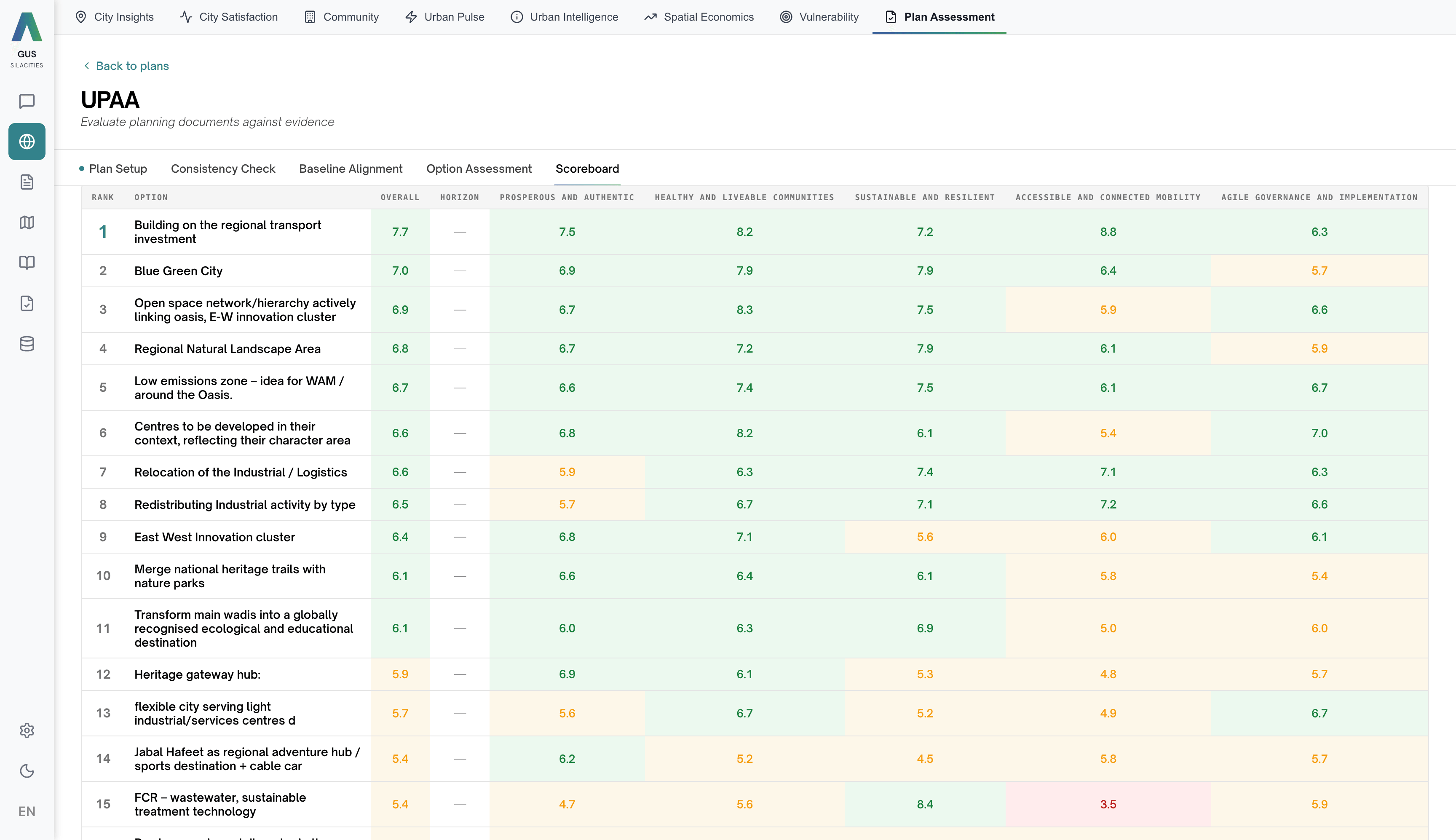
From raw data to an answer you can cite.
Each stage is documented, auditable, and repeatable. Every deployment inherits the same pipeline.
Ingest
Spatial, social and economic data from government portals, satellite and aerial imagery, sensor networks, licensed datasets and client uploads. Every source is provenance-tagged.
Validate
Automated validation rules, outlier detection, cross-source verification, temporal consistency checks and spatial accuracy validation. Expert review on high-stakes data.
Model
Documented model architectures across both our own NLP models (sentiment and emotion, trained on Arabic and multilingual urban text) and the frontier LLMs we orchestrate for chat and vision. Training-data provenance tracking, regular performance audits, bias detection, explainability techniques, human-in-the-loop validation.
Analyse
Statistical significance testing, confidence intervals reported, assumptions documented, limitations acknowledged. Peer review by domain experts before any claim ships.
Deliver
Every answer is cited to source and date. Methodology disclosed alongside the output. Regular data refresh, continuous feedback loops, no locked-box results.
What we refuse to compromise on.
If a deliverable would break one of these, we don’t ship it.
Transparency over mystique
Methods, limits and known biases are disclosed alongside every deliverable. No black boxes.
Privacy by design
Strict data minimisation, anonymisation at ingest, isolation between deployments. No cross-client queries, no exceptions.
Fairness, tested
Models are tested for differential performance across demographic groups. Where bias exists, we name it before shipping.
Accountability, named
Every recommendation has an author. Methodology appendices name who ran the model and who reviewed the output.
Where the signal comes from.
Coverage and licensing vary by deployment. Every ingested dataset is tagged with its source family, provenance, and last refresh date before it enters the platform.
What GUS does not, and will not, pretend to do.
GUS outputs are decision-support, not decisions. Every deployment ships with a documented list of what the platform can answer with confidence, what it can answer with caveats, and what it should refuse to answer at all. This is the public-facing version of that list.
AI-generated, human-reviewed
GUS Chat, GUS Consult and Fieldnotes drafts use frontier LLMs orchestrated by SilaCities. Every output is cited back to source data and dated. AI-generated outputs intended for procurement, regulation, or public policy are reviewed by a named human before delivery.
Low-confidence answers refuse
Where the underlying data is too thin, too stale, or too geographically uneven to support an honest answer, GUS surfaces a refusal with the reason on the page rather than fabricating a number. The refusal rate is logged and reported quarterly.
Coverage varies by city
Spatial coverage, sentiment dialect coverage and demographic granularity vary by deployment. New cities begin with a documented coverage matrix that names what is available, what is partial, and what is not yet supported. We do not extrapolate across gaps without flagging it.
Not a substitute for statutory process
GUS does not replace statutory planning consultation, environmental assessment, equality impact analysis, or any regulatory process where local law assigns authority to a specific officer or body. It accelerates the evidence base those processes draw on.
Need the full technical methodology for procurement?
For RFPs, audits or academic review we share a detailed methodology document under NDA. It covers model architectures, training data provenance, validation protocols and known limitations.
Talk to the methodology team
Speak with the people who design and audit the pipeline.