
Find out how people actually live in your city.Planning, for people.
Atlas is where most of the day's work happens inside GUS. Eight tabs, each a different lens on how people actually live in your city, all on the same neighbourhood grid: City Insights, City Satisfaction, Community, Urban Pulse, Urban Intelligence, Spatial Economics, Vulnerability, Plan Assessment. Pick a tab, frame an area, read what's there. The ✦ Ask dock travels with you across every tab and replies in plain language with cited evidence.
From "open Atlas" to "this is the district" in a few clicks.
Pick a tab, scope the area, filter the metric, ask the assistant.
Pick a tab
City Insights · City Satisfaction · Community · Urban Pulse · Urban Intelligence · Spatial Economics · Vulnerability · Plan Assessment.
Scope the area
Switch the scale picker between Hex, Community or District. Multi-select specific districts or communities with the unit picker. The map, KPI cards and charts update without an Apply button.
Filter
Narrow by topic, year, demographic segment or sector. Filters and scope carry across every tab, so a question you start in Satisfaction picks up where you left off in Community.
Ask
Open the ✦ Ask dock from the scope bar. It reads the same layers you are looking at, replies with inline citations, and toggles between "this view" and "broader" against the full city dataset.
See how people actually live in your city.
Each lens runs its own analysis against the same fused dataset on the same neighbourhood grid. The AI assistant follows you across every one, so a question in Satisfaction picks up where you left off in Community.
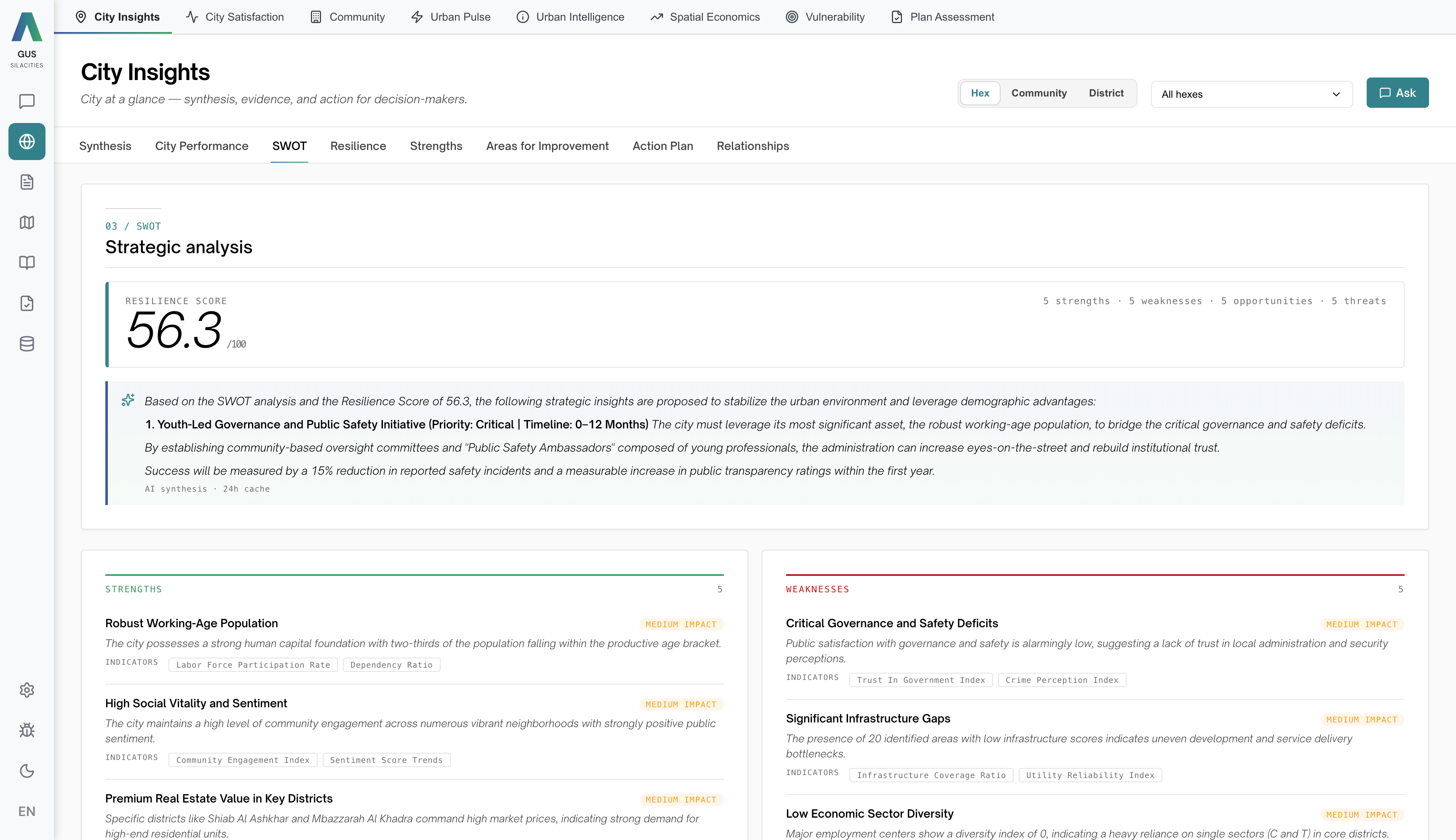
City Insights
The overall read on the city. Health score, SWOT, strengths and weaknesses, resilience, areas for improvement, relationships and an AI synthesis. The tab to open first.
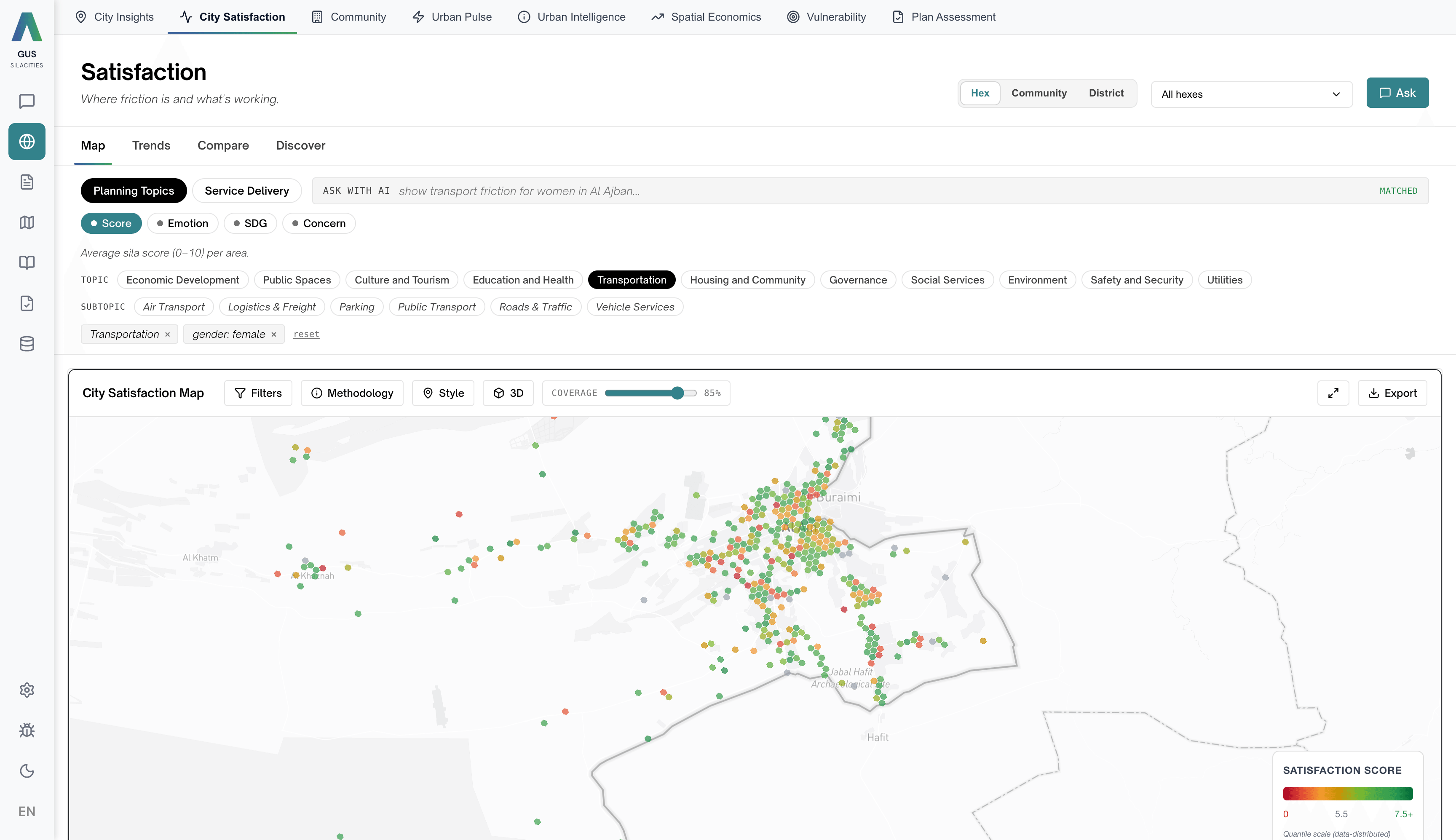
City Satisfaction
Citizen satisfaction by topic, subtopic, district and time. Coloured hex by hex on a 0 to 10 Sila Score. Powered by the Social Atlas engine with Arabic-native sentiment across 20+ dialects. 84%+ correlation with face-to-face surveys.
Community
A single-scroll profile of any area you pick. Summary, recommendations, People, Economy, Built Environment and Character — one tab, every layer the city has on that neighbourhood.
Urban Pulse
Vitality and activity. Foot traffic, temporal patterns by hour and day of week, seasonal rhythm, the places that are alive at the times that matter. Powered by the Urban Pulse engine on real-time feeds.
Urban Intelligence
A scored assessment across eight dimensions of how a place actually performs. Each dimension scored 0 to 100 with a band from Critical to Thriving. Powered by the Urban Spaces engine on computer vision, NLP and ML clustering. Exports to PDF in one click.
Spatial Economics
Jobs, industries, economic clusters, real-estate prices and land-use efficiency. Six internal views across the same hex grid. ISIC-classified at neighbourhood resolution, employment distribution, sector mix, retail activity, supply-demand gap.
Vulnerability
Satisfaction-based equity analysis. Disparities across districts, service gaps, leverage points and an AI-generated action plan that turns each gap into a recommended intervention.
Plan Assessment
Upload a planning document, run a five-stage evidence check, and walk out with a ranked scorecard. The strategic-plan evaluation tab that has its own dedicated tool page too.
Every tab carries the same scope bar: scale picker (Hex / Community / District), unit multi-select for specific districts, and the ✦ Ask dock — an AI assistant that follows you across every tab, picks up your filters, and answers in plain language with inline citations.
Sentiment, behaviour and place — read together.
The Social Atlas engine turns resident feedback into defensible evidence. Arabic-native sentiment across 20+ dialects, 81+ liveability indicators mapped to neighbourhood level, dual-layer classification across 15 service domains and 11 SDG-aligned planning categories. 1,500 to 3,000 feedback items per minute at city scale. 84%+ correlation with independent face-to-face surveys. Calibrated satisfaction with the aspect that drove the experience and the emotion behind it.
The Urban Pulse engine reads how the city moves. Footfall, visitor flows, dwell times, seasonal patterns. Real-time feeds fused against the same neighbourhood grid as every other layer, so a satisfaction gap in one district and the mobility pattern running through it are always read together.
The Urban Spaces engine reads how public places actually perform. Computer vision on satellite and street-level imagery for physical condition. NLP captures how residents describe the space. Machine learning clusters every space in the city into typologies, identifies amenity gaps and generates design recommendations grounded in how spaces behave.
What Atlas does that a BI tool cannot.
8 views of your city
From insights to AI assistant. You turn views on and off per deployment. Your team sees only what they need.
One shared scale
The Sila Score runs critical to excellent across every topic. One legend, every view.
Time-aware
Every layer knows its date. Pivot any view by year, month or season to see the direction of travel on every indicator.
Drill into any area
Click any neighbourhood for a full profile across every enabled view. Satisfaction, demographics, activity, all on one screen.
AI Assistant, built in
Ask Atlas in plain language. The same conversation thread follows you across every view, reading the layers you have open and replying with the same citations.
Compare districts
Put any two districts side by side across every metric in the view. Surface the gap instantly.
Eleven weeks of neighbourhood diagnosis compressed into a working morning. For the first time, our council and spatial team saw the same evidence on the same screen, cited to the same row.